The Padres didn’t just lose 3–1.
They lost on a moment that felt like it belonged to another era.
Ninth inning. Full count. No outs. Xander Bogaerts staring down a fastball that dipped low. He took it. Started toward first base.
And then froze.
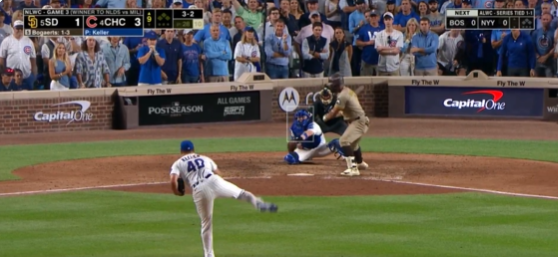
Home plate umpire D.J. Reyburn rung him up.
Strike three.
For Padres fans, it wasn’t just a call. It was a collapse in slow motion.
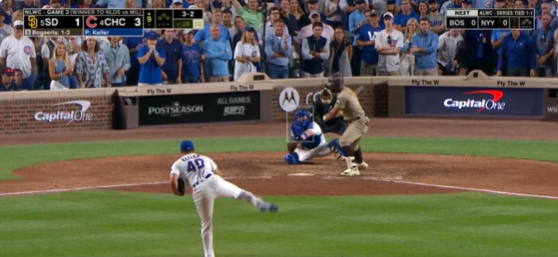
The ESPN broadcast box showed the pitch clearly below the strike zone. Social media ignited instantly. The same question echoed everywhere: next year, with the ABS challenge system arriving in MLB, would this have been overturned?
The short answer?
Yes.
But the longer answer is what makes this moment unsettling.
On Baseball Savant’s generic strike zone model, the pitch barely grazes the bottom edge. It looks defensible. Cubs fans were quick to point to that red dot hugging the zone’s lower boundary.

Proof, they argued.
Except it wasn’t.
Because Keller wasn’t pitching to a generic human. He was pitching to Bogaerts — 6-foot-2, taller than average, with a personalized strike zone that sits higher off the ground.

Under MLB’s upcoming ABS challenge calculations, the bottom of Bogaerts’ zone sits at roughly 1.665 feet at the midpoint of the plate. Keller’s pitch crossed at approximately 1.492 feet.
That’s not borderline.
That’s low.
And it gets worse for the call.

Statcast measures the pitch at the front of the plate. But the ABS zone will evaluate at the midpoint — where gravity has already pulled the ball slightly lower.
In other words, the pitch would have dropped even further below the zone by the time ABS judged it.
Under next year’s rules, Bogaerts walks.

The inning lives.
The season breathes.
Instead, the Padres walked off the field.
This is not just about one pitch. It’s about baseball standing at the edge of technological transformation.
The strike zone has always been a living, breathing thing — shaped by umpire interpretation, catcher framing, and subtle negotiation between pitcher and plate. It’s messy. Human. Emotional.
Carson Kelly’s glove movement on the pitch tells that story perfectly.
He set up low. Brushed the dirt. Received the pitch and subtly flowed the mitt upward into the zone. It wasn’t theatrical. It wasn’t dramatic.
But it was just enough.
Framing has long been baseball’s quiet art — smudging the edges of perception. Not tricking umpires into believing a ball was middle-middle, but nudging the gray area into black-and-white certainty.
Last night, that gray area swallowed San Diego’s season.
And here’s the uncomfortable truth: ABS won’t erase framing entirely. It won’t eliminate debate. It won’t stop players from staring at umpires in disbelief.
But it will remove moments like this from the postseason.
No more guesswork about broadcast graphics. No more arguing generic zones versus individualized ones. No more silence after a full-count walk that wasn’t.
The Bogaerts strikeout now feels like a transitional relic — the final gasp of a system about to be replaced.
Some fans will mourn that loss of human element. Others will celebrate clarity.
But for the Padres, it’s harder to be philosophical.
Because if ABS had existed last night, the inning changes. The pressure shifts. The Cubs don’t celebrate yet.
Baseball’s future is coming.
And one pitch below the zone may have just convinced an entire fanbase it can’t arrive fast enough.
Leave a Reply