The Toronto Blue Jays delivered an elite offensive season in 2025, finishing among baseball’s top teams in nearly every major category except one that quietly limited their ceiling.
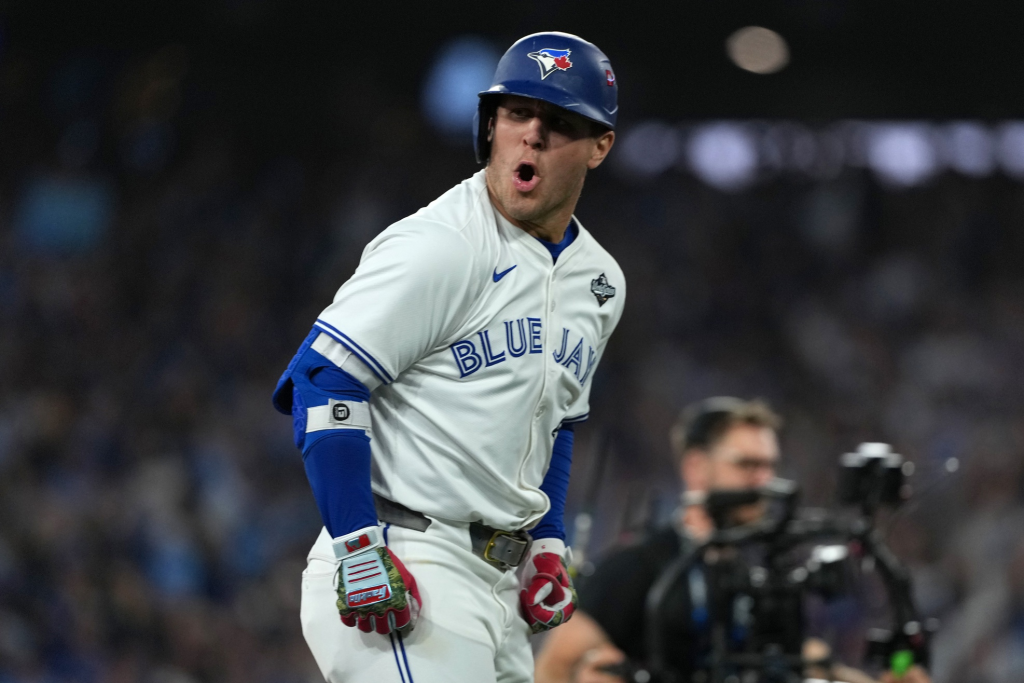
Vladimir Guerrero Jr. is one player who could boost the Blue Jays’ home run total this season. Mandatory Credit: Nick Turchiaro-Imagn Images | Nick Turchiaro-Imagn Images
Despite ranking top five in runs, RBIs, batting average, on-base percentage, and OPS, Toronto finished tied for just 11th in home runs.
That discrepancy mattered more than it appeared, especially for a team built to overwhelm opponents rather than grind out narrow margins.
The root cause was clear almost immediately.
Anthony Santander, signed after a 44-homer season in Baltimore, never came close to replicating that production in Toronto.
Santander’s season unraveled in May, when a violent collision with the outfield wall resulted in a shoulder injury that sidelined him for months.
He returned late in September, made the postseason roster, and briefly offered hope before a back injury ended his year during the ALCS.
Six home runs replaced expectations of thirty-plus, reshaping Toronto’s offensive profile almost by default.
Heading into 2026, projections suggest that imbalance may finally correct itself.
According to composite projections compiled by Thomas Nestico, the Blue Jays are expected to finish seventh in MLB with 213 home runs.
That would represent a jump of twenty-two homers from last season, enough to eliminate their lone offensive weakness.
Reaching that number depends on multiple moving parts, not just Santander’s health.
Bo Bichette’s departure removed power and presence, forcing Toronto to replace production rather than redistribute it internally.
The Blue Jays believe Kazuma Okamoto can shoulder that responsibility.
Okamoto arrives from Japan with a proven power résumé, having hit at least 30 home runs in six consecutive NPB seasons.
His peak came in 2023, when he launched 41 home runs, showcasing elite pull power and bat speed.
The transition to MLB pitching introduces uncertainty, but Toronto didn’t sign Okamoto for moderation.
They signed him to change the shape of their lineup.
Vladimir Guerrero Jr. also looms as a swing factor.
Guerrero finished 2025 with 23 home runs, his lowest full-season total since the shortened 2020 campaign.
The slow start was glaring.
He didn’t homer until his nineteenth game, putting him behind pace almost immediately.
A healthier, more aggressive Guerrero could easily push past thirty homers again, restoring the lineup’s center of gravity.
Daulton Varsho represents another quiet source of upside.
Injury limited him to 271 plate appearances last season, yet he still hit 20 home runs in that span.
That pace exceeded his 2023 output, when he hit 27 homers over more than twice as many plate appearances.
If Varsho stays on the field, his power-speed combination changes the lineup’s bottom half dramatically.
Santander remains the wildcard.
A fully healthy season doesn’t need to replicate his Baltimore peak to matter.
Twenty-five homers would be transformative for Toronto’s offense.
Beyond the stars, incremental gains matter.
Several secondary bats could contribute marginal power increases that compound over a long season.
Toronto didn’t overhaul the offense this winter, despite exploring options.
Instead, they’re betting on normalization rather than reinvention.
That bet aligns with their current position.
The Blue Jays are already American League champions, built on balance, depth, and pitching dominance.
Power is the final lever.
If projections hold, Toronto doesn’t just become more dangerous — it becomes harder to game-plan against.
The margin between returning to the World Series and falling short often comes down to a handful of swings.
In 2025, Toronto didn’t always get them.
In 2026, the numbers suggest they might.
Leave a Reply