Kazuma Okamoto hasn’t played a single regular-season game for the Toronto Blue Jays yet.
And already, the weight on his shoulders has quietly doubled.
According to reports out of the World Baseball Classic circle, Okamoto is officially confirmed to suit up for Team Japan when the tournament begins in early March. The news itself isn’t shocking — Okamoto represented Japan in 2023, and few doubted his intentions.

What’s striking is the timing.
Toronto signed Okamoto to a four-year, $60 million deal with the expectation that he could stabilize a lineup still searching for its post-core identity. He arrives with power credentials few imports can match: six seasons of 30-plus home runs in a league that has actively suppressed offense. He arrives with versatility. He arrives with reputation.
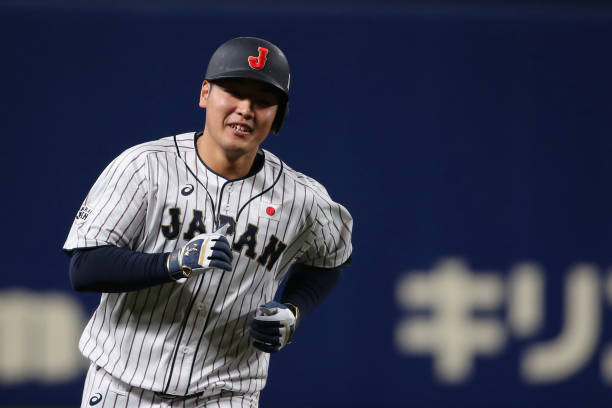
And now, he arrives with obligation.
Before Blue Jays fans see him in meaningful MLB action, Okamoto will step into one of the most emotionally charged environments baseball offers — the WBC, under the lights, wearing the weight of a defending champion’s jersey.
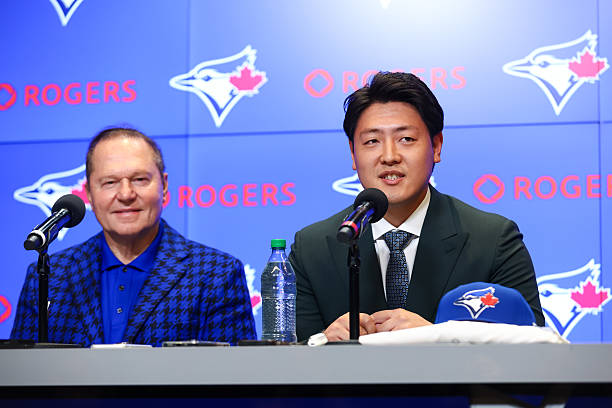
For Japan, this is natural. For Toronto, it’s complicated.
Samurai Japan isn’t easing into this tournament. They’re loading it. Shohei Ohtani. Seiya Suzuki. Yoshinobu Yamamoto. Munetaka Murakami. A roster built not just to compete, but to dominate. Okamoto isn’t a passenger here — he’s expected to contribute, possibly at multiple positions, possibly in high-leverage moments.
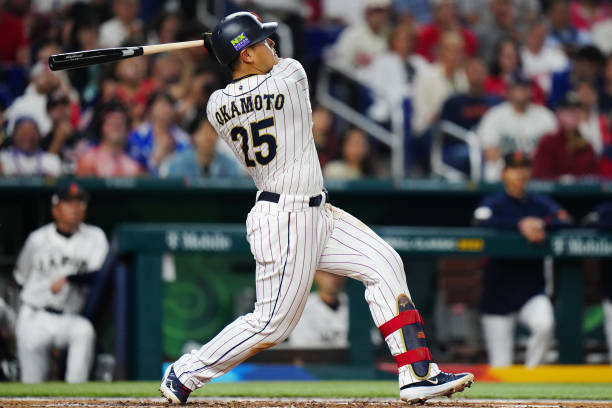
That matters because expectations don’t reset when the uniform changes.
By the time Okamoto reports to Blue Jays camp in full, he won’t be arriving as an unknown adapting quietly to MLB life. He’ll be arriving as a player the world has already judged in March — for better or worse.
And that’s where the quiet pressure creeps in.
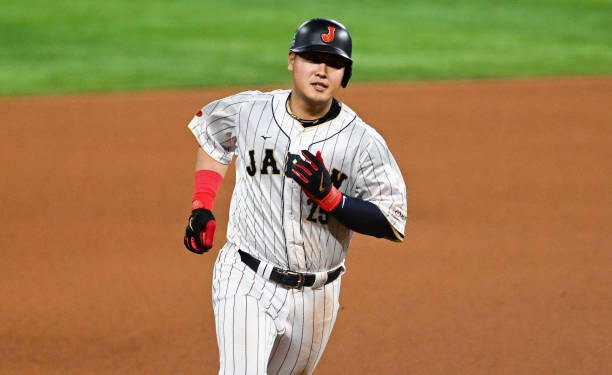
Toronto didn’t just sign a bat. They signed a transition piece. After missing out on Kyle Tucker and Bo Bichette, the Blue Jays need Okamoto to be more than “solid.” They need him to anchor third base, or shift across the diamond when necessary, or stabilize a lineup built on versatility rather than star certainty.
The WBC complicates that arc.
If Okamoto shines, the hype will follow him across the Pacific, raising expectations before he faces his first MLB breaking ball. If he struggles, the questions will start earlier than Toronto ever planned.
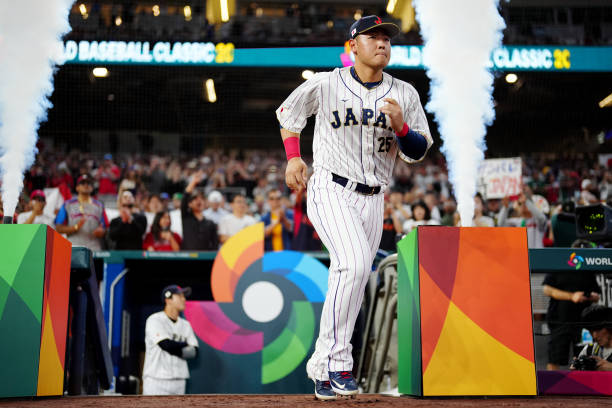
Neither outcome is neutral.
This isn’t about patriotism — no one is questioning that choice. It’s about the reality that international tournaments compress judgment. They don’t allow for gradual adaptation. They don’t care about transition years.
And now, Okamoto’s MLB introduction will happen in the shadow of a global stage that rarely offers patience.
The Blue Jays aren’t alone in this. Vladimir Guerrero Jr. will play for the Dominican Republic. Alejandro Kirk for Mexico. Ernie Clement for Team USA. The difference is context — those players are already known quantities in MLB.
Okamoto is still becoming one.
Japan will ask him to help defend a title.
Toronto will ask him to help define a direction.
Both will be watching closely.
And somewhere between national pride and franchise expectation, Kazuma Okamoto’s real audition will begin — long before Opening Day, long before the season settles, long before anyone planned for the pressure to arrive this early.
Leave a Reply