The Philadelphia Phillies didn’t win the offseason. That much feels clear.

Jun 30, 2025; Pittsburgh, Pennsylvania, USA; Pittsburgh Pirates relief pitcher Chase Shugart (55) pitches against the St. Louis Cardinals during the ninth inning at PNC Park. | Charles LeClaire-Imagn Images
Moves were made, but nothing screamed dominance. Nothing rewired expectations across the league.
And yet, the bullpen feels stronger.
Even after trading away All-Star left-hander Matt Strahm, the relief group entering 2026 is deeper than what Dave Dombrowski had late last season.
Jhoan Duran remains the anchor.
His entrance music will still rattle Citizens Bank Park, and his presence stabilizes the ninth inning without debate.
Behind him, the Phillies added quietly but deliberately.
Brad Keller arrived via free agency. Jonathan Bowlan came back in the Strahm deal. Both add innings and flexibility.
But neither feels like the most intriguing name.
That distinction belongs to Chase Shugart.
The Phillies acquired Shugart from the Pirates earlier this winter, sending minor league infielder Francisco Loreto the other way.
The reaction was muted. Almost nonexistent.
That’s usually how these stories start.

Shugart’s path to Philadelphia wasn’t linear.
A 12th-round pick in 2018, he spent seven seasons buried in the Red Sox system, a place known for refining arms patiently.
He entered as a fringe starter. That experiment didn’t last.
By 2022, Shugart transitioned to relief, where his career finally stabilized.
The real breakthrough came in 2024.
Shugart earned Red Sox Minor League Relief Pitcher of the Year honors, striking out 80 batters across 70⅔ innings.

Later that season, he made his MLB debut.
It didn’t make headlines. It did confirm he belonged.
Roster math eventually caught him.
In January 2025, Boston designated Shugart for assignment, prioritizing catching depth instead of potential bullpen upside.
Pittsburgh claimed him quietly.
There, Shugart did something important.
He proved his success wasn’t contextual.
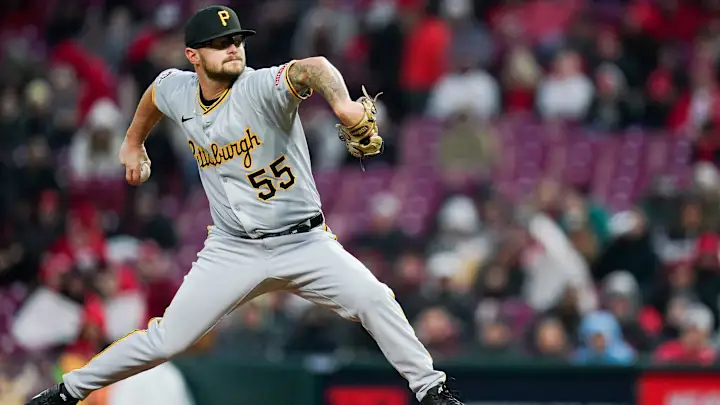
Across 35 appearances with the Pirates, he posted a 3.40 ERA over 45 innings, earning trust when games tightened.
The Pirates didn’t offer many high-leverage moments. When they did, Shugart was often involved.
That trust came from his pitch mix.
Shugart isn’t a pure velocity reliever. His fastball sits around 95 mph, but movement is the real weapon.
His four-seamer carries nearly 15 inches of induced vertical break, enough to play above barrels when sequenced properly.
Still, it’s his breaking pitches that define him.
An 81 mph sweeper with heavy horizontal movement accounts for nearly 30 percent of his usage.
Hitters chase it. Miss it. Respect it.

His cutter comes next.
Thrown around 90 mph, it bridges the gap between speed and movement, forcing uncomfortable decisions from both righties and lefties.
The slider, sinker, and occasional changeup round out a toolkit built on confusion rather than overpowering force.
That versatility is what makes Shugart interesting to Philadelphia.
He’s not locked into a single role.
He can face pockets of a lineup. He can absorb traffic. He can survive inherited runners.
High-leverage middle relief is the projection.
Nothing is guaranteed.
Shugart isn’t assured an Opening Day roster spot. Spring training will be crowded and competitive.
But the Phillies didn’t acquire him for certainty.
They acquired him for optionality.
In a bullpen now filled with known quantities, Shugart represents something different.

A reliever without reputation pressure. Without expectations attached.
Just someone who keeps getting trusted when games tilt.
Those are the arms contenders often discover too late.
And by the time everyone notices, the role is already his.
Leave a Reply