Last February, optimism traveled with the White Sox to Arizona.
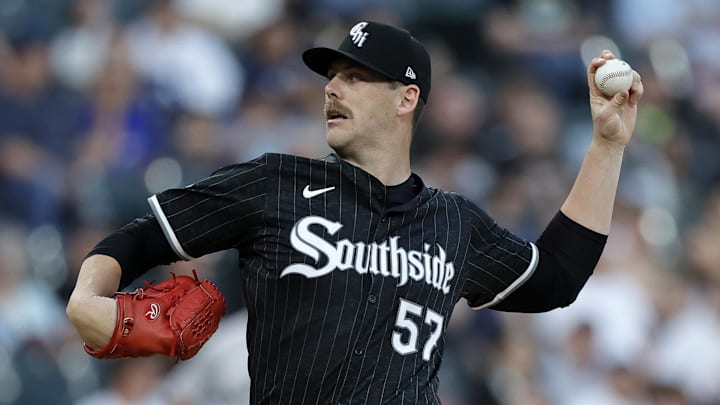
Aug 12, 2024; Chicago, Illinois, USA; Chicago White Sox pitcher Ky Bush (57) throws a pitch during the first inning against the New York Yankees at Guaranteed Rate Field. Mandatory Credit: Kamil Krzaczynski-Imagn Images | Kamil Krzaczynski-Imagn Images
The organization believed its young pitching depth was finally becoming a strength. There was energy around camp. A sense that the next wave was ready to push forward. It felt like progress.
Six weeks later, that optimism was gone.
Ky Bush. Mason Adams. Drew Thorpe. All lost to Tommy John surgery during the ramp-up period. In the span of one spring, near big-league ready depth evaporated. What once looked like stability suddenly felt fragile.
Now, as 2026 Spring Training begins, the lesson from a year ago lingers quietly in the background.
The White Sox don’t just need development this spring.
They need to avoid disaster.

On paper, the projected Opening Day rotation appears serviceable. Shane Smith, Davis Martin, Anthony Kay, Sean Burke, and Erick Fedde give Chicago a workable starting five. It’s not dominant, but it’s competitive enough to stabilize the early months.
Behind them, however, sits the real story.
Tanner McDougal. Noah Schultz. Hagen Smith. Shane Murphy. David Sandlin. Duncan Davitt. An entire wave of young arms waiting for opportunity. Waiting for innings. Waiting to define the next era of White Sox baseball.
And that’s where the stakes rise.

The organization used ten different starting pitchers in 2025, excluding openers. That number alone explains why depth matters. A 162-game season demands reinforcements. It demands durability.
But it also demands patience.
The development of Noah Schultz and Hagen Smith may ultimately define this season. Both are coming off a 2025 campaign they would rather forget. Both are looking to take the next step. Both represent more than just innings — they represent timeline acceleration.

Tanner McDougal’s breakout last year has him on the cusp of a major league debut. David Sandlin, acquired through the Jordan Hicks contract maneuver, carries legitimate upside with multiple plus pitches. These are not filler prospects. They are foundational pieces.
And foundations are not built through desperation call-ups.
Pitching injuries are unpredictable. They don’t announce themselves. They don’t follow clean logic. Even with proper offseason conditioning and cautious build-up programs, arms fail. Historically, the spring ramp-up period remains the most vulnerable window. Velocity climbs. Workloads increase. Muscles and ligaments absorb strain they haven’t felt in months.
It’s naive to expect perfect health. There are still weeks left before Opening Day. Something always happens.
The question is scale.
Last year felt like an epidemic. A chain reaction. An erosion of depth before the first meaningful pitch.
This year, the White Sox can’t afford a repeat.
Because 2026 isn’t just about wins and losses. It’s about trajectory. The organization wants to compete sooner rather than later. Losing one of these young pitchers for the season wouldn’t just hurt the standings — it would stall momentum.
Chicago can always sign a veteran off the scrap heap. There will always be innings eaters available in July or August. But those names don’t move a rebuild forward.
Development does.

A healthy, productive spring from this young group could quietly change the narrative surrounding the franchise. It could signal resilience. Stability. Growth.
But if injuries strike again, the psychological toll may be just as damaging as the physical losses.
Fans can only watch. Hope. Refresh timelines.
Inside the organization, the focus is likely cautious progression. Measured workloads. Controlled expectations.
Because this time, the White Sox aren’t chasing hype.
They’re trying to protect possibility.
A strong and healthy spring won’t guarantee contention. But another wave of arm injuries could guarantee regression.

For a team trying to turn the page, survival might be the first true step forward.
And in Arizona, under clear skies and rising velocity readings, the most important outcome may simply be walking into April with the future still intact.
Leave a Reply