Free agency is supposed to be cold.
Numbers on spreadsheets. Opt-outs. Tax thresholds. Competitive windows measured in decimals and projections.
That’s the language everyone expected when Kazuma Okamoto explained why he chose Toronto.

What they got instead was something quieter—and far more disarming.
“She chose the Blue Jays.”
That was it. No dramatic buildup. No attempt to dress it up. Just a simple explanation that instantly reframed one of the most significant signings of the 2026 offseason.
Before committing to any team, Okamoto did something no agent could model and no executive could anticipate.
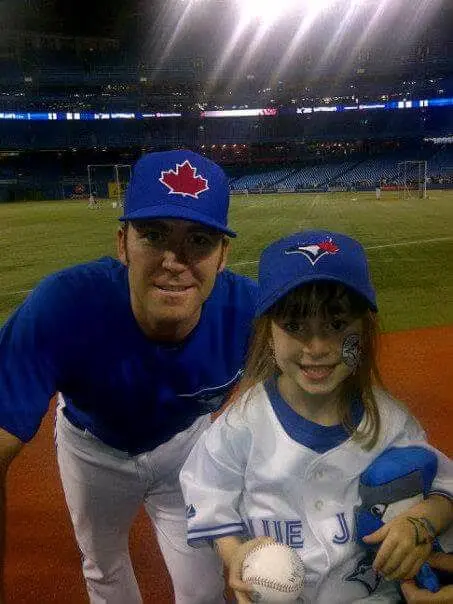
He laid out the logos of all 30 Major League clubs in front of his daughter and asked her to choose her favorite. She didn’t hesitate. She pointed to the Blue Jays’ logo—the blue jay head, the red maple leaf.
And that choice stayed with him.
In a winter defined by aggressive spending and calculated risk, Toronto landed the 29-year-old Japanese slugger on a four-year, $60 million deal.

On paper, it looks like a classic win-now move: $5 million signing bonus, $7 million in 2026, then $16 million annually through 2029. No opt-outs. Stability. Commitment.
But the moment that tipped the scale didn’t happen in a meeting room.
It happened at home.
Okamoto didn’t present the story as destiny or symbolism. He framed it as something simpler: a feeling he couldn’t shake.
In a process full of voices, expectations, and pressure, that small moment cut through the noise. It gave clarity where logic alone couldn’t.
That’s what surprised people.
Toronto’s pursuit was serious. The Blue Jays paid a posting fee of roughly $10.875 million to the Yomiuri Giants, bringing the total investment close to $71 million.
They weren’t dabbling. They were all-in. Still, in a market where multiple teams could offer money and opportunity, the deciding factor wasn’t leverage—it was alignment.
Okamoto arrives with a résumé that justifies the commitment. Eleven seasons in NPB. Two hundred forty-eight home runs. A career slash line of .277/.361/.521.
Six All-Star selections. Six straight seasons of 30-plus homers, peaking with 41 in 2023. Even in an injury-shortened 2025, he posted a .327/.416/.598 line with a career-low strikeout rate.
He’s not a projection. He’s a proven bat.
Analysts expect a middle-of-the-order presence in Toronto—25 to 35 home runs, serious run production, and a disciplined approach that fits the Blue Jays’ offensive identity.
On talent alone, the signing makes sense.
But talent wasn’t the story that traveled.
Fans latched onto the human part immediately. Social media filled with reactions that felt more like smiles than debates. Relief. Amusement.
A strange warmth in a sport that often treats players like assets first and people second.
Toronto’s offseason has already been loud. Dylan Cease. Cody Ponce. Tyler Rogers. Shane Bieber opting in. The payroll pushing into luxury-tax territory. Every move screamed urgency.
Okamoto’s explanation whispered something else.
That even at the highest level, decisions don’t always come down to dominance or destination markets. Sometimes they come down to comfort. To family. To a moment that doesn’t show up in a contract clause.
For Okamoto, the move is still a leap. New league. New travel. New expectations. The transition from NPB to MLB is unforgiving. Nothing is guaranteed.
But as he prepares for spring training—and for representing Japan in the World Baseball Classic—he does so knowing the choice wasn’t just strategic. It was personal.
And when he steps onto the field at Rogers Centre for the first time, fans won’t just be watching a new middle-of-the-order bat.
They’ll be watching the outcome of a decision no front office could have engineered.
One made quietly.
One made at home.
One that still feels a little unexpected.
Leave a Reply