For the Toronto Blue Jays, 2025 was the kind of season you chase for decades — and the kind that comes with a bill.

Baltimore Orioles v Toronto Blue Jays | Cole Burston/GettyImages
Toronto didn’t just make the playoffs. They didn’t just win the division. They won the American League pennant for the first time in 32 years and came within a play or two of winning the World Series.
For a franchise that has lived in the shadow of “what could’ve been,” it was proof that the window is real.
But now that the emotion has cooled, the league is doing what it always does: measuring the future.
And the latest measurement isn’t exactly flattering.
Keith Law of The Athletic released his farm system rankings this week, placing the Blue Jays in Tier 6 — the second-lowest tier — and 25th overall out of 30 teams.
The ranking doesn’t come out of nowhere. It comes from a simple reality Toronto embraced last summer:
They traded prospect capital to try to win right now.
Law even acknowledged the context, writing that it’s only fair to remember the Jays “nearly won the World Series” and moved “nearly all of their top pitching prospects after Trey Yesavage” to bolster the roster for the stretch run.

In other words, this isn’t a failure.
It’s a consequence.
But consequences don’t wait politely.
They show up when the margin for error gets tight — and in the AL East, the margin for error is already razor-thin.
Why this ranking matters more than fans want to admit

Most Toronto fans won’t lose sleep over being 25th in a farm ranking. In fact, plenty would argue it’s the correct tradeoff. You don’t hang banners for “best pipeline.” You hang banners for pennants.
But the concern isn’t about pride.
It’s about leverage.
Because Law’s ranking doesn’t just say Toronto’s system is thin. It says Toronto’s system is thin while the rest of the division is loaded.
That’s the part that should make Blue Jays fans uneasy.
According to the rankings, the Baltimore Orioles are ninth overall, and the Boston Red Sox are right behind them. The Tampa Bay Rays sit in Tier 5 at 16th overall, while the New York Yankees come in at 20th.
Toronto isn’t just behind.
They’re behind the teams they have to fight every single night.
And that creates two very real problems that can show up at the worst possible time: replacements and trade ammunition.
Problem #1: Replacements when things go wrong
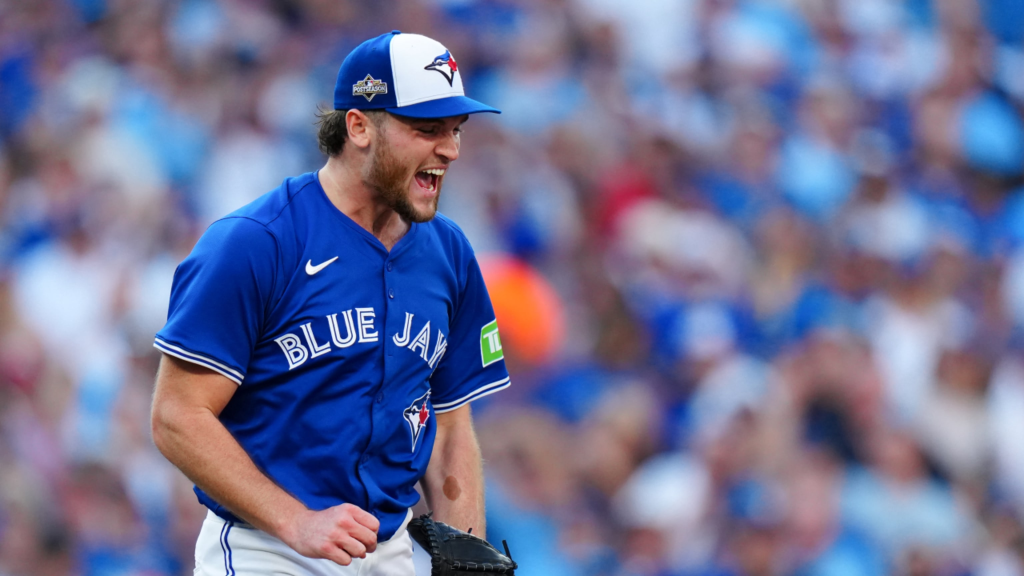
Every contender sells the same dream in March: health, momentum, chemistry.
Then the season starts, and reality shows up.
Injuries happen. Underperformance happens. Slumps happen. Bullpens collapse. A starter misses a month. A lineup spot becomes a black hole. And the best teams don’t just survive that — they absorb it.
How?
By calling up impact prospects who are ready to contribute.
If Toronto’s rivals have stronger systems, they theoretically have more high-end talent ready to jump in and stabilize the roster when something breaks. The Jays, with a thinner pipeline, may not have the same luxury.
And in a division this competitive, “luxury” becomes “difference-maker.”
Problem #2: Trade chips at the deadline

The bigger fear isn’t the call-ups.
It’s July.
Because the teams that win the AL East usually aren’t the ones that start the season perfect. They’re the ones that fix their flaws before the deadline and come out of August looking sharper than everyone else.
And that’s where farm strength becomes a weapon.
Teams with deeper systems can outbid you. They can trade for the extra starter. The bullpen arm. The lefty bat. The missing piece.
Toronto, having already cashed in prospects to chase 2025, might not have the same bargaining power in 2026 — even if they’re just one move away from another pennant run.
The AL East projections make it feel even worse

FanGraphs recently released ZiPS standings projections, and the numbers tell the story of how brutal this division is about to be:
- Blue Jays: 90–72
- Red Sox: 90–72
- Orioles: 88–74
- Yankees: 87–75
That’s not separation.
That’s a knife fight.
And when projected win totals are that close before a single pitch is thrown, one extra trade at the deadline can swing the entire race.
One prospect package can be the difference between winning the division… or spending October on the road in a Wild Card series.
So… should Toronto panic?
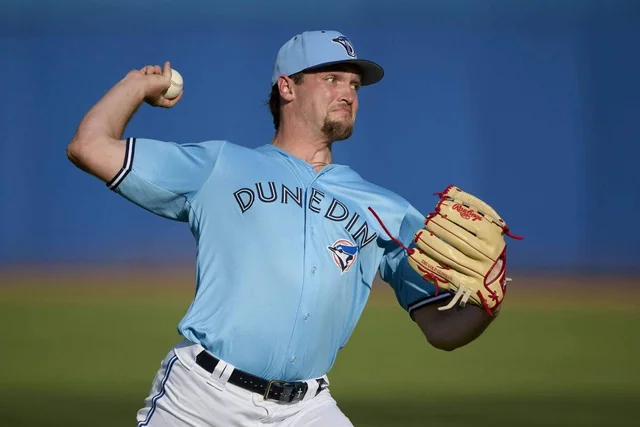
No.
Not yet.
The Blue Jays did what contenders are supposed to do: they went for it. They built a roster strong enough to win the American League. They came painfully close to finishing the job.
And this offseason, they’ve added enough major-league depth to survive more than one punch.
But the warning is still there.
If Toronto doesn’t get a surprise prospect breakout in 2026 — or if they don’t rebuild the pipeline faster than expected — the Blue Jays could find themselves in the worst possible position:
Good enough to contend… but not deep enough to finish.
And in a division where everyone else has ammo, that’s the kind of disadvantage that doesn’t show up in April.
It shows up when the season is on the line. ⚡
Leave a Reply