For a while, the Emmanuel Clase situation felt contained.
Uncomfortable, yes—but limited. A few suspicious moments. A narrow timeline. Something the league could frame as isolated while the legal process unfolded quietly in the background.
That illusion may no longer hold.
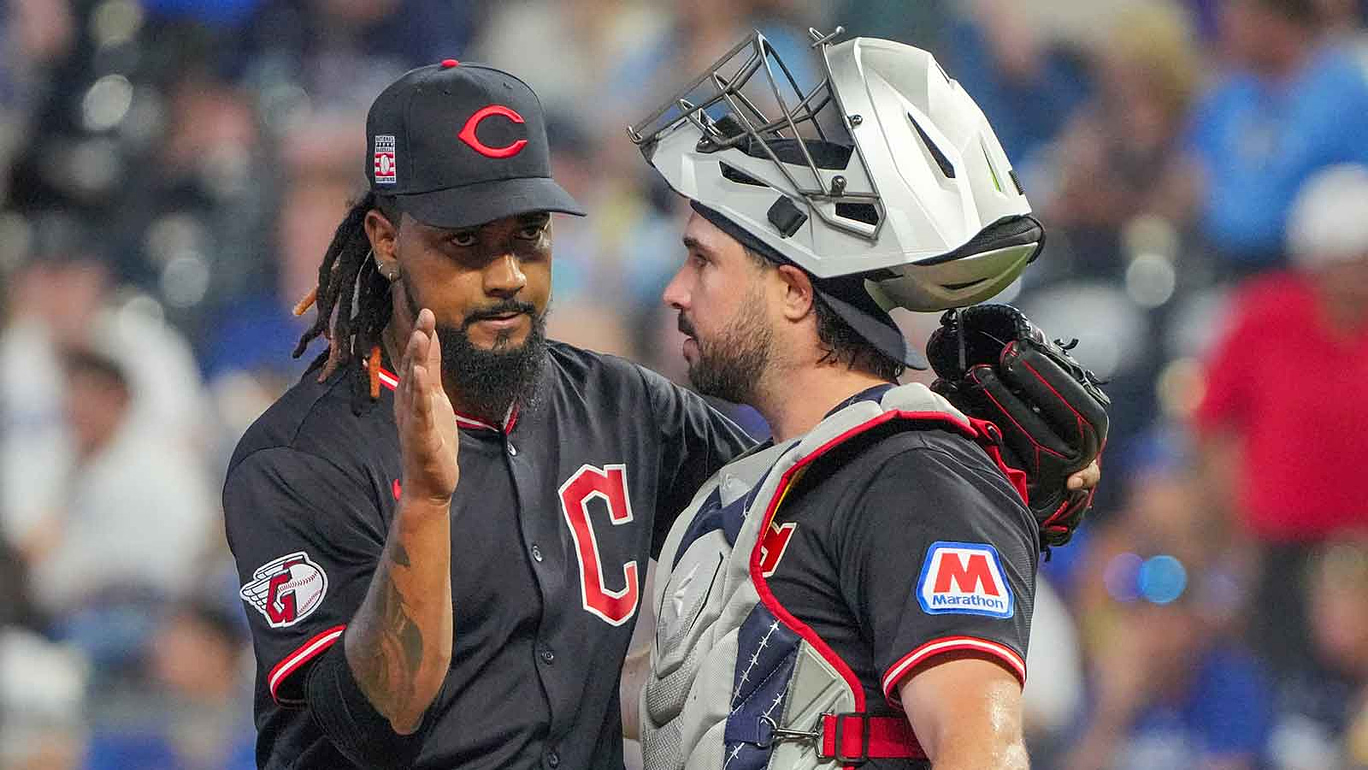
A newly filed court document has dramatically expanded the scope of allegations surrounding the former Cleveland Guardians closer, suggesting the situation may be far broader—and far more unsettling—than initially understood.
According to reporting from ESPN’s David Purdum, a filing submitted Thursday claims Clase is accused of throwing suspect pitches in at least 48 games across a two-year span.
The allegation alone doesn’t determine guilt, but its scale changes the conversation entirely.

Forty-eight games is not a footnote. It’s a pattern—if proven—and that distinction matters.
The document, authored by attorney Cristos Georgalis, was filed in connection with the case involving pitcher Luis Ortiz.
In it, Georgalis asserts that prosecutors possess evidence indicating Clase’s alleged conduct spans roughly 26 months, including dozens of communications with a bettor, cash transfers, and coordination of illegal wagers.

It’s important to pause here.
These are allegations, not conclusions. Clase has not been convicted, and the legal process is ongoing. But the filing reframes the case in a way that’s impossible to ignore.
What once appeared to be a limited inquiry now looks, at minimum, like a sprawling investigation with implications well beyond one player.

The comparison within the filing is particularly striking. Ortiz, according to the same document, is accused of involvement in just two games. Clase’s alleged number is more than twenty times that.
That disparity alone raises uncomfortable questions.
If the accusations hold weight, how did something this extensive remain undetected for so long? And if they don’t, why does the evidence being referenced by prosecutors appear so expansive?

For Major League Baseball, this is a nightmare scenario—not because of one player, but because of what it suggests about oversight in the modern betting era.
Sports betting is now woven deeply into baseball’s ecosystem. Ads line the broadcasts. Odds are discussed openly.
Data is everywhere. MLB has insisted its safeguards are strong enough to protect the integrity of the game.
This case tests that claim in real time.

Clase was not a fringe arm. He was one of the most dominant closers in baseball, trusted in the highest-leverage moments, often when games—and bets—were hanging in the balance.
That context is what makes the allegations feel so destabilizing.
If even a fraction of what’s outlined in the filing proves accurate, it forces the league to confront how vulnerable late-game situations truly are in a betting-saturated environment.
The Guardians organization, meanwhile, remains in an awkward position. Clase is no longer active with the team, but his legacy is still intertwined with their recent success.
Every new detail pulls the franchise back into a story it would rather move past.
Fans are left in limbo.
Some feel betrayed. Others urge caution, pointing out how easily reputations can be destroyed before facts are established. Both reactions coexist—and neither feels entirely satisfying.
What’s undeniable is that this filing changes the tone.
It turns the case from a curiosity into a reckoning. Not just for Clase, but for MLB’s ability to police itself in an era where the line between competition and commerce has never been thinner.
As the legal process continues, clarity will eventually come.
But for now, baseball is stuck in an uncomfortable in-between—where the allegations are too serious to dismiss, and the answers too incomplete to settle the storm.
And that uncertainty may be the most damaging part of all.
Leave a Reply