Fernando Tatis Jr. doesn’t sound frustrated anymore.
That, more than any stat line, may be the most revealing sign heading into 2026.
After a 2025 season that oscillated between brilliance and inconsistency, the Padres star speaks now with calm certainty. The adjustments are behind him, he says.

The doubts too. What’s coming next, in his words, will be “really special.”
Confidence has never been Tatis’ problem. Context has.
At 27, he’s no longer the league’s most electric unknown. He’s a finished product in the eyes of many — an All-Star, an MVP candidate, a Platinum Glove winner.

And yet, listening to him reflect on last season, it’s clear he doesn’t see himself that way.
He sees unfinished business.
Tatis’ 2025 numbers were strong by any reasonable standard: 25 home runs, 32 stolen bases, a .268/.368/.446 slash line, eighth in NL MVP voting, and elite defense in the outfield.
But what lingers in his own assessment isn’t achievement — it’s interruption.

Mechanical drift. Mental noise. A swing that never fully settled.
Those are the things he insists are now behind him.
“I know this year on the offensive side it’s going to be really special,” Tatis said, a statement that lands differently when viewed through the Padres’ broader reality.
San Diego doesn’t just need improvement. They need a statement season from their most visible star.
Because the Dodgers aren’t slowing down.
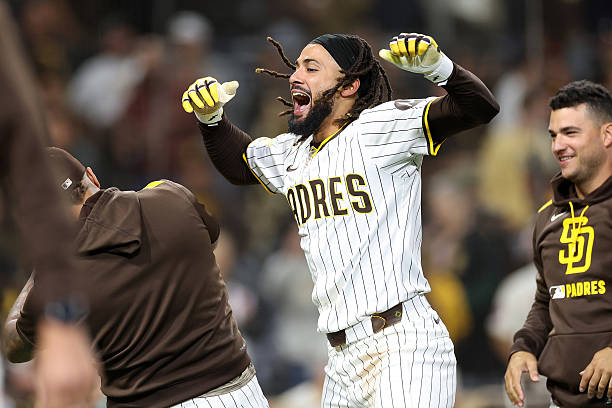
In a division defined by imbalance, the Padres’ margin for error is thin. Manny Machado remains the backbone, but Tatis is the accelerant — the player capable of tilting series, weeks, even seasons.
When he’s consistent, San Diego believes it can stare down anyone.
When he’s not, belief turns fragile.
What makes 2026 feel heavier is timing. This isn’t about promise anymore. This is the convergence point where physical prime, experience, and expectation collide.
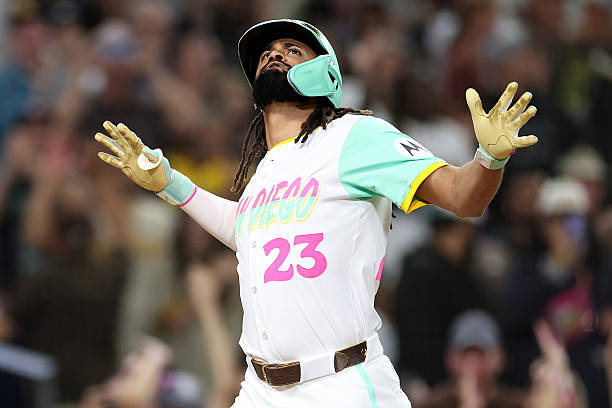
Tatis himself acknowledges it, saying his best years are ahead — not hypothetically, but imminently.
“There’s no limit,” he said.
That line sounds empowering. It also sounds like pressure.
Last season, Tatis described his struggles as mental and mechanical, not physical. That distinction matters. It suggests the ceiling was never the issue — only access to it.

Now he frames the upcoming year as a personal proving ground, not against critics, but against his own standards.
That’s a harder opponent.
Leadership adds another layer. Tatis isn’t just asked to perform; he’s expected to set tone. Younger players watch him. The clubhouse listens.
The Padres’ identity, especially offensively, still orbits around his presence.
Confidence is contagious. So is inconsistency.
San Diego’s coaching staff will emphasize balance — aggression without recklessness, intensity without burnout. Health will be monitored. Workloads managed.
But none of that substitutes for the thing the Padres quietly need most.
Reliability.
The Dodgers don’t beat teams with one superstar moment. They beat them by stacking inevitability. For the Padres to close that gap, Tatis must become less explosive — and more inevitable himself.
That doesn’t mean fewer highlights. It means fewer disappearances.
In that sense, 2026 isn’t about a breakout in the traditional sense. Tatis has already broken through. This season is about consolidation — turning flashes into baseline, confidence into consistency.
He sounds ready. The words are steady. The optimism controlled.
But baseball has a way of testing declarations.
And as the Padres chase the Dodgers, the real chase may be more personal: Fernando Tatis Jr. trying to finally align the player he knows he can be with the one the league sees every night.
Leave a Reply