The Houston Astros knew they would have to navigate the early part of the season without Josh Hader. What they didn’t expect was how quickly things could begin to unravel.
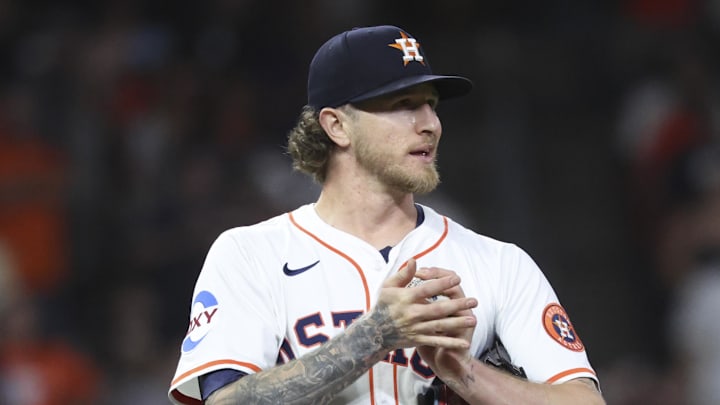
Houston Astros relief pitcher Josh Hader | Troy Taormina-Imagn Images
Hader, sidelined since February with biceps tendinitis, isn’t expected back until at least mid-April—and possibly later. That absence has already started to expose cracks in Houston’s bullpen, putting pressure on roles that once felt secure.
Manager Joe Espada moved swiftly to fill the void, handing closing duties to Bryan Abreu. On paper, the decision made sense. Abreu has long been one of the club’s most trusted late-inning arms.
But early returns suggest the transition hasn’t gone smoothly.
In limited action so far, Abreu has struggled to command the moment. During a recent appearance against the Los Angeles Angels, he nearly let a comfortable lead slip away. After entering with a three-run cushion, things quickly spiraled—free passes, a wild pitch, and mounting pressure forced an early exit.
It was a sequence that raised eyebrows, not just for the result, but for how quickly control seemed to vanish.
Houston ultimately escaped thanks to Bryan King, who steadied the inning and shut the door. His composure helped salvage the win, but it also highlighted a growing question: who should really be trusted in the ninth?
The issue runs deeper than one shaky outing.
Across their opening series, Astros relievers were heavily taxed, covering 18 innings. That kind of workload this early in the season can expose depth—and Houston’s has looked uneven. While some arms have stepped up, others appear out of sync.
AJ Blubaugh has been a bright spot, delivering multiple innings with efficiency and control. Kai-Wei Teng has also done his job quietly, limiting damage and keeping the team in games.
But inconsistency from the rest of the group has complicated things.
Pitchers like Christian Roa, Ryan Weiss, and Roddery Muñoz have yet to find rhythm. Some of that can be traced to limited support from the starting rotation, but the lack of reliable high-leverage options is becoming harder to ignore.
Roster flexibility only adds another layer to the problem.
Certain pitchers can be sent down without much consequence, while others come with complications. Muñoz, for instance, would have to be offered back to the Cincinnati Reds due to his Rule 5 status. That kind of restriction limits Houston’s ability to make quick fixes.
For now, it’s too early to call it a crisis—but the warning signs are there.
If Abreu falters again, Espada may be forced to reconsider his approach. A shift toward a more flexible closing strategy—or even an unexpected promotion for a hotter hand—could be on the table sooner than anticipated.
Because until Hader returns, the Astros don’t just need someone to fill the role—they need someone who can hold it together when it matters most.
Leave a Reply