The Toronto Blue Jays are off to a perfect start—but it’s not just the wins that stand out.
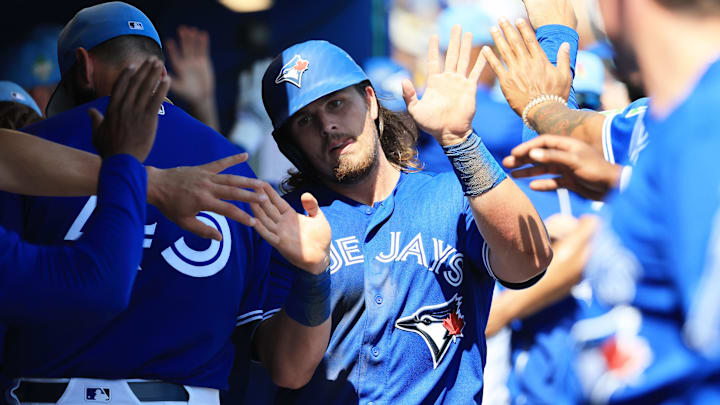
Mar 10, 2026; Dunedin, Florida, USA; Toronto Blue Jays third baseman Addison Barger (47) celebrates after scoring during the fourth inning against the Atlanta Braves at TD Ballpark. Mandatory Credit: Kim Klement Neitzel-Imagn Images | Kim Klement Neitzel-Imagn Images
Back-to-back walk-off victories over the Athletics have given Toronto a 2-0 record to open 2026. More importantly, they’ve revealed something deeper about this roster—something that could quietly become a defining advantage over the course of the season.
This team has options. A lot of them.
Friday’s win followed a more traditional path.

Toronto leaned on its starters and made minimal adjustments late in the game. Manager John Schneider used his bench just once, inserting Myles Straw as a defensive replacement in the ninth inning. It was straightforward, controlled, and effective.
Saturday told a completely different story.
Trailing 6-2 in the seventh inning, the Blue Jays needed a spark—and Schneider turned aggressively to his bench to find it. That’s when the flexibility of this roster came into full view.
Jesús Sánchez, making his team debut after an offseason trade, was called upon to lead off the inning as a pinch hitter. Facing a right-handed pitcher, the lefty Sánchez provided an immediate presence.
He didn’t even need to swing.

Sánchez was hit by a pitch, reaching base and setting the tone for a comeback. He stayed in the game afterward, contributing further with a hit, an RBI, and a run scored—making an instant impact in his first appearance with Toronto.
The moves didn’t stop there.
Addison Barger was also brought in as a pinch hitter, another lefty bat inserted for matchup advantage. While his first at-bat resulted in an out, he later delivered when it mattered most—drawing a walk and eventually driving in the tying run with a sacrifice fly in the 10th inning.
Every move seemed intentional. Every adjustment had a purpose.

Then came the 11th inning—and another key decision.
Instead of sticking with Kazuma Okamoto as the automatic runner at second base, Schneider opted for speed, replacing him with Nathan Lukes. That choice paid off immediately, as Lukes came around to score the game-winning run on Ernie Clement’s line drive.
It was a small detail—but a decisive one.
And it highlighted a broader theme: this roster isn’t built around just one identity.
Through two games, Schneider has already used nearly every player available, mixing and matching based on matchups, defensive needs, and game situations. Whether it’s lefty-righty advantages, defensive versatility, or late-game speed, the Blue Jays have shown they can adapt on the fly.
That kind of flexibility is rare—and dangerous.

It gives Toronto multiple paths to win games, whether they’re protecting a lead or chasing one. It also puts constant pressure on opposing managers, who can’t settle into predictable patterns.
Early in the season, that unpredictability is already paying off.
Two games. Two walk-offs. Two very different approaches.
If this is a preview of what’s to come, the Blue Jays may not just be winning games—they may be forcing opponents to play their game on Toronto’s terms all season long.
Leave a Reply