The New York Mets already have a lot riding on Brett Baty in 2026.
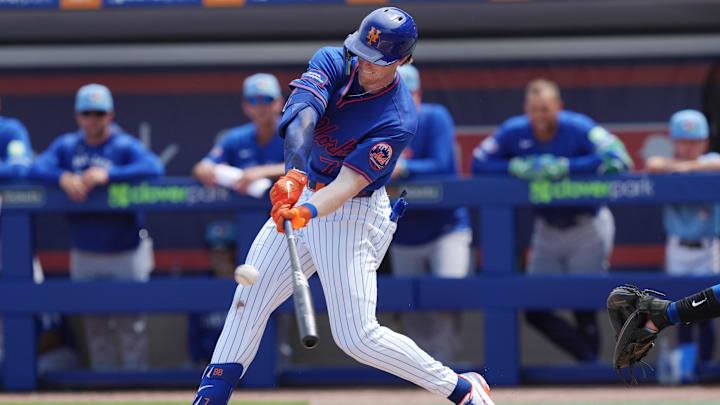
Mar 15, 2026; Port St. Lucie, Florida, USA; New York Mets third baseman Brett Baty (7) gets a base hit in the second inning against the Toronto Blue Jays at Clover Park. Mandatory Credit: Jim Rassol-Imagn Images | Jim Rassol-Imagn Images
Now they might be asking for even more.
Baty has quickly become one of the most important and versatile pieces on the Mets roster. Whether he’s playing first base, filling in at right field, or shifting wherever needed, his role is less about one position — and more about solving problems.
And another one may have just landed on his plate.

With top prospect Carson Benge officially making the Opening Day roster, it seemed like Baty’s time in right field would shrink. But in reality, it might not disappear at all.
In fact, it could become even more situationally important.
The Mets will likely manage Luis Robert Jr.’s workload throughout the season, giving him regular rest. At the same time, there are valid questions about how Benge will perform against left-handed pitching early in his MLB career.
That opens the door for Baty.
When lefties are on the mound, New York has a few options in right field — but none are perfect. Tyrone Taylor is one alternative, yet his struggles against southpaws last season make him a less-than-ideal choice. He posted a .211/.297/.256 line against left-handers, continuing a trend of reverse splits.
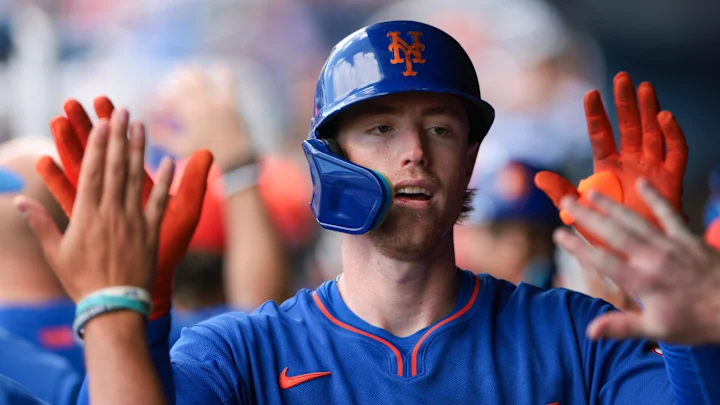
Baty, on the other hand, wasn’t dominant — but he was serviceable.
He hit .247/.301/.377 against lefties, which, while not eye-popping, is significantly more reliable than the alternatives. In a lineup trying to maximize every matchup, that difference matters.
Then there’s Benge.
While the rookie earned his spot with a strong spring, his minor league numbers against left-handed pitching (.232/.407/.323) suggest there could be an adjustment period — especially against MLB-caliber arms.
That’s where Baty could quietly become the Mets’ best short-term solution.

Rather than force Benge into difficult matchups early, the Mets can ease him in while deploying Baty in right field against lefties. It’s part of a broader strategy that could involve rotating players like Mark Vientos and Jorge Polanco at first base and DH depending on matchups.
The result? A constantly shifting lineup built on flexibility.
And Baty is at the center of it.
Of course, this kind of role comes with risk. Defensive lapses in right field could quickly change the equation. Likewise, if Baty proves significantly better at first base, the Mets may choose to keep him there instead.
But for now, the plan seems clear: give Baty as many ways to contribute as possible.
That includes one more challenge — becoming a dependable bat against left-handed pitching.

It’s a lot to ask from a young player still finding his footing in the majors. But if Baty can handle it, he won’t just be a useful piece for the Mets.
He could be the glue that holds their entire lineup together.
Leave a Reply