The Houston Astros fixed their rotation.
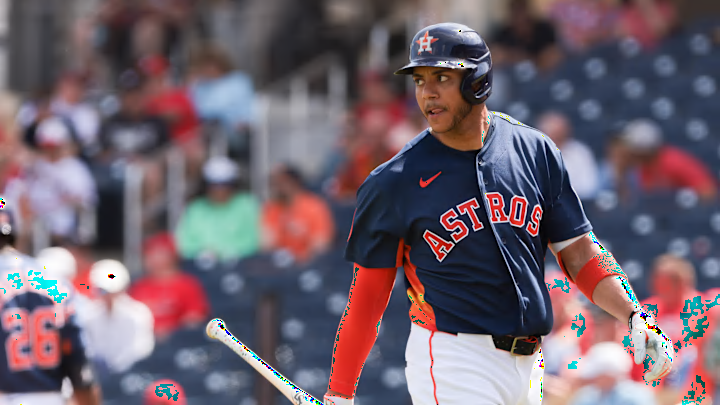
Houston Astros shortstop Jeremy Pena looks on. | Sam Navarro-Imagn Images
Now they have to prove they didn’t weaken everything else.
After a 2025 season derailed by injuries and uneven offense, Houston entered a clear retooling phase. The additions of Tatsuya Imai and Mike Burrows — paired with Hunter Brown — give the Astros a deeper, more balanced pitching staff.
On paper, the arms are good enough to compete.
The question is whether the bats are.
An ESPN lineup evaluation by Bradford Doolittle recently ranked Houston 13th overall, assigning an 82.1 rating across eight categories. The deeper concern wasn’t star power — it was profile.
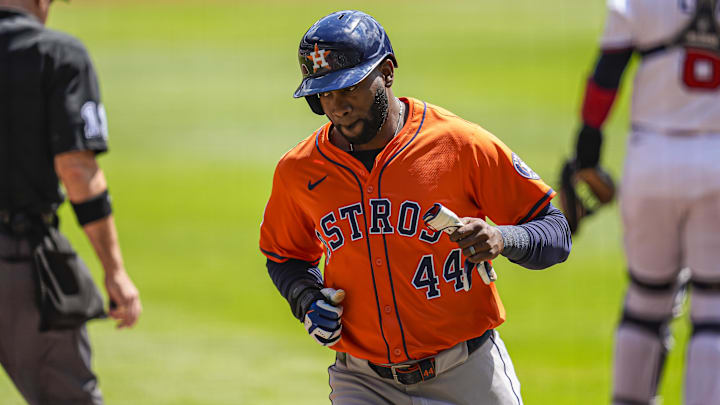
Houston Astros left fielder Yordan Alvarez scores a run. | Dale Zanine-Imagn Images
“Paper-thin, slow, overly aggressive and dependent on batting average,” Doolittle wrote, noting that healthy seasons from Jeremy Peña and Yordan Alvarez could mask some flaws.
That’s not exactly a ringing endorsement.
At the top, Houston still features recognizable names: Peña, Jose Altuve, and Alvarez. That trio can anchor any lineup when clicking. But beyond them, the drop-off becomes more noticeable.
Depth — once an Astros hallmark — now looks thinner.
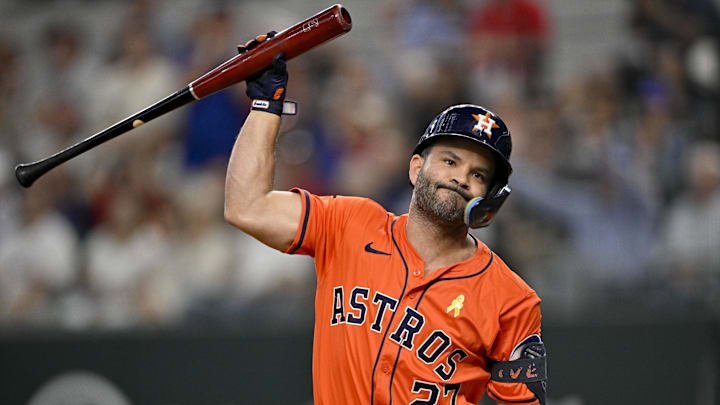
Houston Astros’ Jose Altuve throws his bat. | Jerome Miron-Imagn Images
Mauricio Dubón, Jesús Sánchez, and Victor Caratini are gone. The primary reinforcement was a reunion with Joey Loperfido. That’s not insignificant, but it’s not transformative either.
If injuries strike again, Houston may not have enough insulation.
That vulnerability is magnified by approach.
For years, the Astros built their identity around disciplined at-bats. They didn’t just avoid strikeouts — they controlled tempo, extended counts, and wore down pitchers. In 2025, while they remained a low-strikeout club, they failed to draw walks consistently, finishing 26th in total walks with just 471.
That’s a major shift from the model that fueled their most dominant seasons.

Manager Joe Espada appears aware of it.
Through the first three spring training games, Houston drew 29 walks — a small sample, but an encouraging one. Espada emphasized the goal of “getting back to our identity,” stressing pitch selection and controlling at-bats.
If that trend holds, it could reshape the offense.
Still, everything circles back to Alvarez.

When healthy, he changes the geometry of the field. He lengthens the lineup. He protects others. But Houston’s margin for error shrinks dramatically if he misses time or plays compromised.
Altuve remains productive, but at this stage of his career, expecting him to carry the offense nightly isn’t realistic. Peña and Carlos Correa can contribute, yet neither is built to anchor the lineup alone.
There’s enough talent here to compete in the A.L. West.
But there’s less cushion than in years past.

The Astros have the pitching to keep games tight. What they must rediscover is patience, depth, and resilience at the plate. If the top stays healthy and the approach improves, Houston can absolutely re-enter the postseason picture.
If not, 2026 could become a season where the lineup — not the rotation — holds them back.
Leave a Reply