Time is not on the Houston Astros’ side.
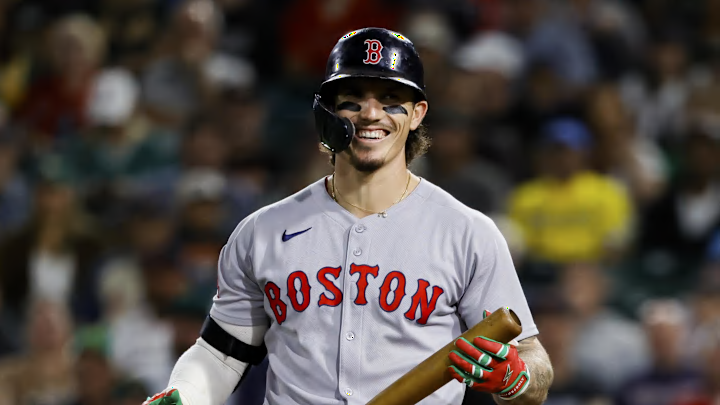
Sep 9, 2025; West Sacramento, California, USA; Boston Red Sox left fielder Jarren Duran (16) smiles after getting hit by a pitch during the ninth inning against the Athletics at Sutter Health Park. Mandatory Credit: Sergio Estrada-Imagn Images | Sergio Estrada-Imagn Images
With Opening Day approaching, general manager Dana Brown has made it clear the front office would still like to make another move. The checklist isn’t small: a backup catcher, a left-handed hitting outfielder, and clarity around the Christian Walker–Isaac Paredes infield situation.
But potential trade partners are drying up.

One recently floated idea — a deal with the Boston Red Sox — now feels increasingly unrealistic.
Bleacher Report’s Zach Rymer proposed Jarren Duran as a logical fit for Houston’s search for left-handed outfield help. On paper, it makes sense. Duran would bring speed, athleticism, and balance to a lineup that leans right-handed.
The problem? Boston’s incentives have changed.
Earlier this offseason, the Red Sox were heavily linked to Paredes. At one point, Houston believed it had framework traction on a multi-team deal involving Boston and St. Louis that would have landed Brendan Donovan with the Astros.

Instead, Donovan went to Seattle. Boston pivoted.
The Red Sox acquired Caleb Durbin and later added Isiah Kiner-Falefa to their infield mix. Those moves significantly reduced any urgency to pursue Paredes. If Boston isn’t motivated to upgrade at third base, the foundation of a Paredes-centered trade erodes quickly.
There’s also the matter of preference.

Reports suggested Houston was more interested in Wilyer Abreu than Duran in prior discussions. And even if Boston were willing to entertain talks, the Astros’ farm system doesn’t currently boast a deep pool of upper-level pitching prospects — something the Red Sox have targeted in recent deals.
At this stage of spring training, leverage shifts toward continuity.

Teams grow comfortable with their internal options. Roster battles clarify. Unless injuries create sudden need, major trades become harder to justify.
That doesn’t mean Houston is done exploring.
Adding a backup catcher still feels plausible. That type of move typically costs less and can materialize quickly. But solving the outfield imbalance or the infield logjam may have to wait — or require a different, unexpected partner.
Spring training always leaves room for surprises.

Yet right now, the once-discussed Astros–Red Sox pathway appears colder than ever.
And if Houston enters the regular season without addressing those roster questions, it won’t be for lack of trying — it may simply be because the market moved on first.
Leave a Reply