The New York Mets’ farm system continues to evolve—and in some cases, it’s moving faster than expected.

Citi Field. | Vincent Carchietta-Imagn Images
Even among a group filled with highly regarded young talent, one name is beginning to separate himself in a surprising way. And in the process, he’s already reshaping how evaluators view the organization’s future.
That player is Wandy Asigen.
At just 16 years old, Asigen has quickly climbed prospect rankings, now being viewed by some evaluators as a more exciting talent than 18-year-old Elian Peña—one of the Mets’ most hyped international signings in recent years.

It’s a notable shift.
Peña entered the system with significant expectations, backed by a sizable signing bonus and a skill set that checks nearly every box. After a slow start to last season, he rebounded impressively, showcasing power, speed, and advanced plate discipline in the Dominican Summer League.
Those tools haven’t disappeared.
In fact, Peña is still widely viewed as one of the premier young prospects in baseball. Multiple outlets have ranked him among the top international talents of his class, and projections continue to place him at the center of the Mets’ long-term plans.
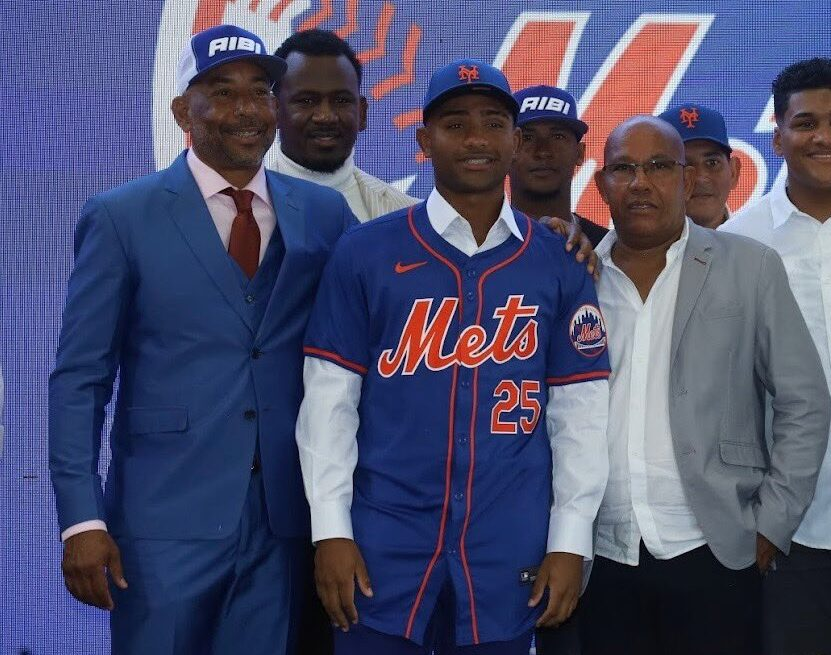
But Asigen’s emergence is forcing a new conversation.
According to recent evaluations, he’s already being ranked higher within the system by some analysts. That alone would be surprising—but the context makes it even more intriguing.
Asigen wasn’t just another international signing.
He was originally tied to the New York Yankees before re-entering the market, creating an unexpected opportunity that the Mets capitalized on. For a franchise always looking to gain an edge in player development, it was a rare moment—and one that may already be paying off.
The early reports are striking.
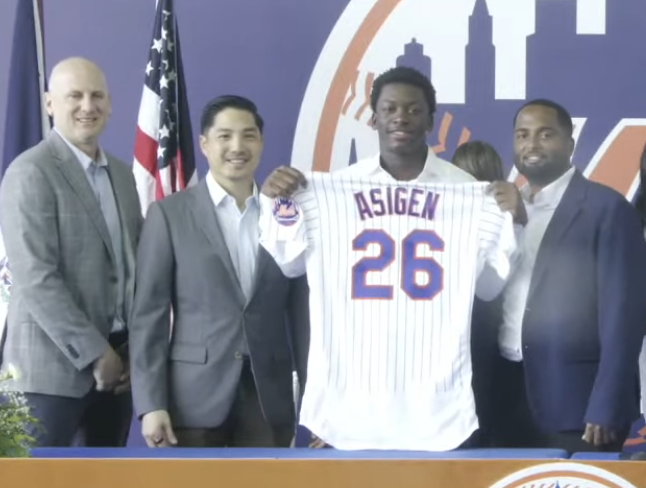
Scouts have praised Asigen’s all-around profile, with some suggesting he could have been a top-five selection if he were part of a traditional amateur draft. His bat speed stands out, and his overall athleticism gives him the potential to impact the game in multiple ways.
Of course, there are still questions.
Like many young hitters, his approach will be tested as he climbs the minor league ladder. Adjusting to higher velocity—especially elevated fastballs—will be a key part of his development.
But at this stage, the upside is undeniable.
And perhaps most importantly, there’s time.

Asigen hasn’t even turned 17 yet, meaning his development path is just beginning. For the Mets, that patience could prove valuable as they continue building a pipeline of young talent capable of sustaining success at the major league level.
For the Yankees, the situation may sting a bit more.
Losing a prospect of this caliber—especially one now generating this level of buzz—adds another layer to an already competitive rivalry. Whether the circumstances were connected or coincidental, the outcome is clear: the Mets took advantage of an opportunity.
Now, they may have another cornerstone in the making.
And if early evaluations hold true, this could be one of those rare moves that looks even more significant with time.
Leave a Reply