The Philadelphia Phillies opened the season with energy, optimism, and just enough excitement to believe things might be different this time.
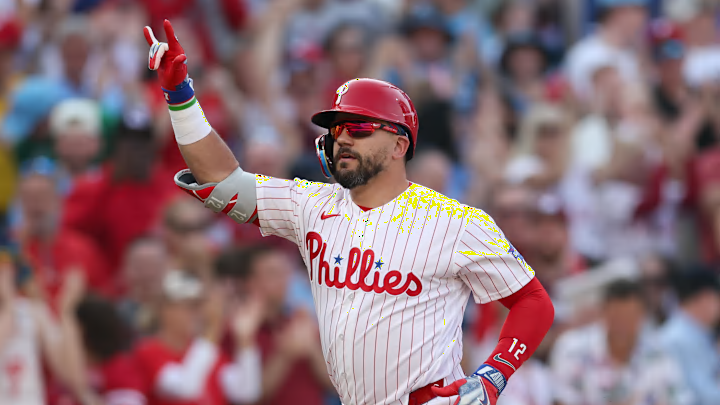
Philadelphia Phillies left fielder Kyle Schwarber. | Bill Streicher-Imagn Images
There were real positives. Justin Crawford brought a spark in his debut. Cristopher Sánchez looked dominant. And Jhoan Durán managed to slam the door when it mattered most.
But that momentum didn’t last long.
As the opening series unfolded, a familiar issue crept back into focus—one that has quietly followed this team for years. When the stars go cold, the offense struggles to function.
And early signs suggest that hasn’t changed.
The trio of Trea Turner, Bryce Harper, and Kyle Schwarber drives everything for Philadelphia. When they’re producing, the lineup feels dangerous from top to bottom.
When they’re not, the entire structure starts to wobble.
That’s exactly what happened against the Texas Rangers.
Across multiple games, the Phillies’ biggest names went quiet at the plate. The result wasn’t just a dip in production—it was a lineup that struggled to generate consistent pressure or capitalize on opportunities.
To be fair, the supporting cast didn’t disappear.
Alec Bohm delivered strong at-bats. Bryson Stott and Brandon Marsh found ways to contribute. Even from the bottom of the order, there were flashes of life.
But it wasn’t enough.
Because this lineup isn’t built to carry its stars—it’s built around them.
That distinction matters.

Over the course of a 162-game season, even elite hitters will go through slumps. It’s inevitable. The difference between good teams and great ones is how they respond in those moments.
Right now, the Phillies’ response looks uncertain.
There were brief signs of resilience, including a late-game push that nearly flipped one of the losses. But those moments felt more reactive than sustainable. When facing strong pitching, the offense struggled to create rhythm early—and spent too much time playing from behind.
That’s a dangerous pattern.
Especially when looking beyond April.
Because while small sample sizes can be misleading, they can also be revealing. The postseason, after all, is built on short stretches—where depth, adaptability, and timely hitting matter just as much as star power.

And that’s where the concern deepens.
If the Phillies remain overly dependent on their top three hitters, they risk running into the same ceiling that has limited them before. Strong opponents will find ways to neutralize even the best bats.
When that happens, someone else has to step up.
For now, it’s early. There’s plenty of time for adjustments, for the stars to heat up, and for the lineup to find balance.
But the warning signs are already there.
And if they don’t address them, this could become less of an early-season hiccup—and more of a season-long theme.
Leave a Reply