The Toronto Blue Jays aren’t entering the 2026 season simply hoping to win games.
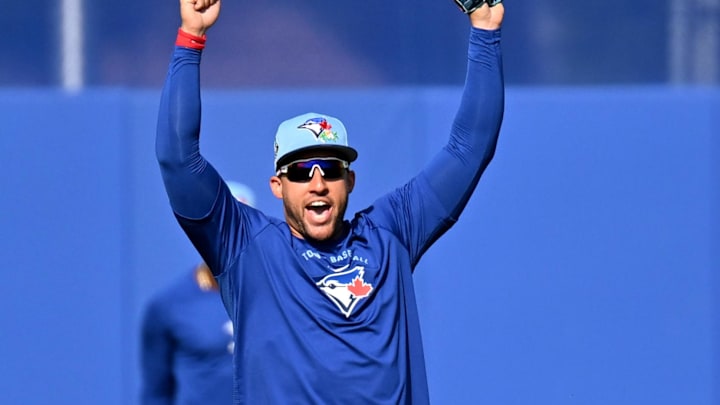
Blue Jays outfielder George Springer celebrates after catching a fly ball during spring training at Bobby Mattick Training Center at Englebert Complex. | Jonathan Dyer-Imagn Images
They’re trying to become something more complete.
After falling just short of a championship last year, the organization understands that talent alone isn’t enough to finish the job. A World Series contender must combine pitching depth, offensive firepower, late-game reliability, and mental resilience over the course of a long season.
Inside the clubhouse, the goal is clear: build a team capable of defending its division title while finally finishing the journey.
That blueprint revolves around four key elements — a dominant pitching staff, a reliable bullpen to close games, a powerful lineup, and the ability to move on quickly from setbacks.
A rotation built to dominate

Blue Jays pitcher Kevin Gausman (34), pitcher Dylan Cease (84), pitcher Cody Ponce (37) watch the bullpen pitchers for spring training practice | Kim Klement Neitzel-Imagn Images
Toronto’s biggest offseason focus was pitching.
The Blue Jays leaned heavily on their offense during the 2025 campaign, but the front office made it clear they wanted a deeper, more intimidating rotation moving forward. On paper, the 2026 pitching staff could become one of the strongest in baseball.
The group features a mix of veteran experience and emerging talent.
Kevin Gausman and José Berríos remain anchors of the rotation, while Shane Bieber and Max Scherzer bring championship experience and proven track records. New additions like Dylan Cease and Cody Ponce strengthen the depth behind them.
And then there is Trey Yesavage.
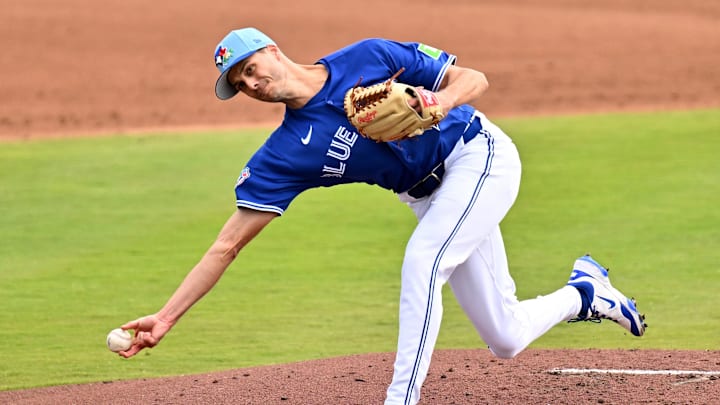
Blue Jays relief pitcher Tyler Rogers (71) throws a pitch in the second inning against the Florida Marlins during spring training at TD Ballpark | Jonathan Dyer-Imagn Images
The young right-hander became one of baseball’s most unexpected postseason stars last year, delivering a dominant World Series performance that captured national attention. After beginning the season in Single-A, Yesavage ended it by tying a rookie World Series strikeout record.
His emergence gives Toronto another high-ceiling arm capable of changing games.
If the rotation performs as expected, the Blue Jays could redefine themselves as a pitching-first club.
Fixing the late-game problem

For all of Toronto’s success in 2025, one painful weakness haunted them during the World Series.
They couldn’t close games.
Multiple late-inning opportunities slipped away against the Los Angeles Dodgers, allowing the championship to slip from their grasp.
The Blue Jays addressed that issue by strengthening the bullpen — particularly with the addition of Tyler Rogers.
Rogers posted a sub-2.00 ERA last season along with a remarkable 0.94 WHIP. His presence should provide the type of stability Toronto lacked in the final innings last October.
With Rogers helping anchor the bullpen, the expectation is that late-game leads will be far more secure.
A lineup built around proven stars

Offensively, the Blue Jays still possess one of the most dangerous cores in the American League.
George Springer and Vladimir Guerrero Jr. remain the heart of the lineup, providing both experience and production. Around them, Toronto has built a group capable of delivering power and run production throughout the order.
Daulton Varsho and Addison Barger could play particularly important roles.
Both players hit at least 20 home runs last season, while Barger also drove in more than 70 runs during his breakout campaign. If those numbers hold steady — or improve — the Blue Jays lineup could remain among the league’s most productive.
The projected batting order also includes players whose performance could swing the season.
Kazuma Okamoto, making the jump to Major League Baseball, has yet to face big league pitching. Meanwhile, Andrés Giménez is looking to rebound after finishing last season with a .210 batting average.
If both players deliver consistent production, the lineup’s depth becomes significantly more dangerous.
The mental challenge of a long season

Beyond statistics and roster construction, there’s another factor every contender must master: resilience.
The 162-game schedule inevitably brings losing streaks, slumps, and moments of frustration. Successful teams understand how to move past them quickly.
The Blue Jays are emphasizing that mindset heading into 2026.
Players know that dwelling on individual losses or difficult stretches can create mental barriers. Resetting after each game — whether it ends in victory or defeat — is essential to maintaining momentum.
A championship still within reach
Toronto enters the season as one of the favorites to win the American League East once again.
But the team’s ambitions go far beyond the division standings.
The Blue Jays came painfully close to a championship last year. That experience now serves as both motivation and unfinished business.
If their pitching holds up, the bullpen secures late leads, and the lineup delivers consistent production, Toronto could find itself back on baseball’s biggest stage.
And this time, the goal won’t just be getting there.
It will be finishing the job.
Leave a Reply