Canada rises, U.S. retreats — and the future of North American manufacturing hangs in the balance
For years, global automakers viewed North America as the safest bet in global manufacturing—a region defined by economic stability, predictable policy, and consumer demand strong enough to fuel decades of growth.
But that era has ended.
This week, Honda Motor Co. confirmed a stunning two-year delay to its highly anticipated $15 billion electric vehicle initiative in Canada—an industrial mega-project once hailed as the future centerpiece of the continent’s clean transportation movement. The announcement did not arrive quietly. It sent shockwaves across boardrooms in Detroit, Washington, Toronto, and Tokyo, forcing investors, suppliers, and policymakers to confront a harsh new reality:
President Donald Trump’s import tariffs are reshaping the auto industry—just not in the way he promised.
The Tariff Squeeze
Honda executives were blunt. Profit projections have collapsed by 60%, an almost unthinkable tumble for one of the world’s most disciplined and financially conservative automakers. The primary culprit: U.S. import tariffs reaching as high as 50%, targeting foreign-made vehicles, parts, metals, and batteries.
These policies were marketed as economic armor—designed to protect American workers, revive manufacturing, and punish overseas competitors.
Instead, Honda estimates $4.3 billion in global losses, with more than half directly tied to Trump-era tariffs and retaliatory trade measures.
Cars cost more to build. Shipments cost more to move. Inventories cost more to store. Suppliers cost more to retain. And consumers, facing rising sticker prices, are buying fewer vehicles—especially EVs.
The message from the auto industry is clear:
A market cannot thrive when trade becomes a battlefield.

Car dealership
A Delay That Echoes Across Borders
Honda’s Ontario project was never just another factory—it was a transformative national vision.
Announced with fanfare, government support, and global optimism, the initiative included:
- A $5+ billion federal-provincial investment package
- A state-of-the-art EV assembly plant
- Battery production facilities and raw material partnerships
- Thousands of expected long-term jobs
- A new Canadian foothold in the global clean-energy market
Production was slated for 2028. Now, that timeline has shifted to 2030, leaving suppliers idle, unions anxious, and regional planners scrambling.
Honda described the delay as a “strategic recalibration” in response to “unpredictable U.S. economic conditions.”
Translation:
America is no longer a reliable manufacturing partner.
Canada Seizes the Opportunity
While the U.S. escalates tariffs, Canada is playing the long game.
Ottawa has framed the transition to electric vehicles not as a marketplace gamble, but as a generational industrial revolution—one requiring certainty, incentives, and international cooperation.

In the past five years, Canada has attracted more than $46 billion in EV-related investment, pulling in automakers, battery developers, mining companies, and technology firms from Europe, Asia, and the U.S.
Toyota has expanded its hybrid operations in Ontario. BMW is exploring battery partnerships. Hyundai is quietly evaluating Canadian production opportunities.
The country has positioned itself as:
✅ Politically stable
✅ Trade-friendly
✅ Resource-rich
✅ Climate-focused
✅ Strategically located near the U.S. market—without the policy chaos
While Trump raises walls, Canada builds manufacturing bridges.
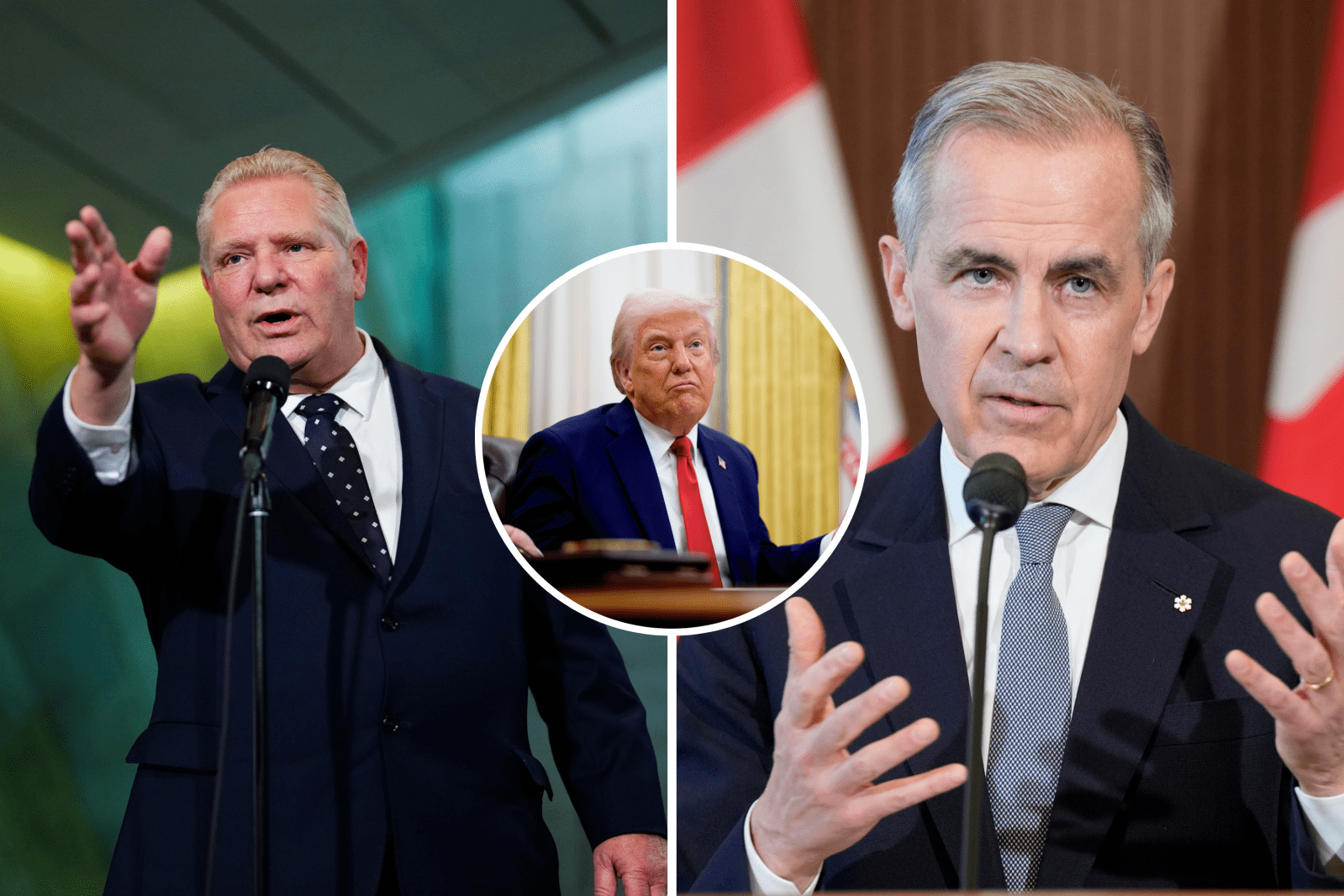
The American Industry Crisis
Trump promised a revival—factories humming, steel mills roaring, assembly lines returning from overseas. Instead, automakers are cutting shifts, scaling back production, and sounding alarm bells.
Ford, GM, and Stellantis have all issued warnings about thinning margins, limited investment capacity, and unpredictable costs. Ford executives reportedly reacted with concern to Honda’s announcement—interpreting it as a preview of what’s coming.
Even domestic automakers cannot escape tariffs.
Many U.S.-built cars rely on:
Car dealership
- Chinese and Korean battery cells
- Japanese drivetrains and electronic systems
- Mexican wiring harnesses
- European semiconductors
Punish foreign imports, and American vehicles become more expensive to build.
Punish allied manufacturing partners, and the U.S. supply chain fractures.
Consumers ultimately pay the price—with rising MSRPs now outpacing wage growth.
The Global Auto World Responds
Other major economies are watching Trump closely—and reacting accordingly.
United Kingdom — Nervous
London fears tariffs could weaken exports from British automakers like Jaguar Land Rover and Mini, further destabilizing a post-Brexit manufacturing sector already fighting for survival.
European Union — Cautious
Brussels is preparing retaliatory tariffs but hopes to avoid escalation. German automakers, in particular, rely heavily on the U.S. market.
China — Unfazed
Chinese EV giants such as BYD, SAIC, and NIO are thriving, expanding aggressively into Europe, Latin America, and Southeast Asia—markets not subject to Trump’s trade penalties.
If the U.S. isolates itself, China will simply dominate everywhere else.

A Warning Wrapped in Data
Industry analysts now argue that the competitive advantage in global manufacturing no longer belongs to the country with the biggest market—but to the country with the least political volatility.
Economic resilience depends on:
- Long-term policy predictability
- Stable trade agreements
- Consistent regulatory frameworks
- International cooperation
- Trust
And trust, once lost, is not easily rebuilt.
Did Protectionism Backfire?
Trump’s supporters insist tariffs will eventually push companies to relocate factories back to the U.S. But so far, evidence suggests the opposite.
Instead of moving into America, companies are:
- Delaying investments
- Shifting production to Canada
- Expanding European partnerships
- Doubling down on Asia
Why?
Uncertainty scares capital more than competition.
And corporations—especially multinational automakers—do not gamble with billions.
The Canadian Contrast
Canada’s approach stands in near-perfect ideological opposition to Trump’s.
Where the U.S. punishes imports, Canada rewards innovation.
Where the U.S. threatens foreign partners, Canada courts them.
Where the U.S. imposes tariffs, Canada provides grants and tax credits.
Ottawa is not trying to control global trade—it’s trying to attract it.
That philosophy is working.
Even with the Honda delay, Canada remains the fastest-growing EV investment destination in the Western Hemisphere.
A Turning Point for North America
Honda’s decision forces a difficult question:
Can the U.S. rebuild its industrial strength while isolating itself economically?
So far, the evidence says no.
Manufacturing is not nationalism.
It is interdependence.
It is collaboration.
It is shared risk, shared resources, shared strategy.
Every car built in North America is a multinational artifact—physically assembled in one place, economically supported by dozens of others.
Car dealership
You cannot tariff your way to industrial dominance.
The Future Is Being Chosen Now
The automotive industry has survived oil shocks, recessions, wars, technological revolutions, and global pandemics.
It will survive tariffs, too.
But where it survives—and where it thrives—is being determined today.
If trends continue, Canada may soon become the continent’s clean-energy manufacturing capital, while the U.S. becomes a high-cost, low-output outlier.
The world’s automakers are not waiting for Washington to change course.
They are adapting.
Some quietly.
Some urgently.
Some publicly—like Honda.
The Final Reality
Honda’s paused project is not a failure.
It is a warning.
A warning to investors, workers, consumers, and political leaders:
Trade policy is no longer background noise.
It is destiny.
And right now, Canada is writing the future—while the United States risks walking backward.
The question now is not whether the U.S. wants to lead the EV era.
It is whether it is willing to compete for it.
Because in the global economy, walls don’t protect industries.
They isolate them.

The shift in the industrial landscape raises critical questions about the future of U.S. manufacturing. Can a nation truly rebuild its industrial base while isolating itself from the very networks that sustain it? The answer may lie in the evolving global economy, where trust and cooperation are becoming the new currencies of trade.

As the automotive industry stands at a crossroads, the decisions made today will shape the competitive landscape for years to come. With Canada emerging as a formidable player in the EV market, the U.S. must reconsider its approach or risk losing its manufacturing edge permanently. In this new era, policy foresight and strategic collaboration will determine the winners and losers in the global supply chain.
Leave a Reply