Tobias Myers doesn’t look like the typical pitcher the New York Mets have been targeting.
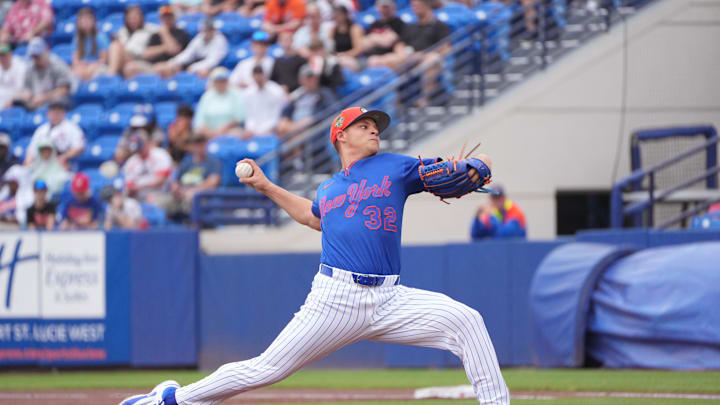
And that’s exactly what makes him so intriguing.
In an era where velocity, strikeouts, and advanced metrics often define success, Myers stands out for doing things differently. He doesn’t overpower hitters. He doesn’t rack up eye-popping strikeout totals. And yet, he continues to produce results that are hard to ignore.
Heading into 2026, his role is clear.
Whether in the rotation or out of the bullpen, Myers is expected to log meaningful innings for the Mets. He may not headline the staff, but he’s becoming an increasingly important piece—especially for a team that needs reliability more than flash.

What separates Myers from others is his approach.
Unlike many pitchers in the Mets’ system, who rely on velocity and swing-and-miss stuff, Myers leans into contact. He pitches to hitters rather than around them, trusting that weak contact and defensive support will get him through innings efficiently.
It’s a style that doesn’t always win over analysts.
On the surface, his numbers are strong. A 3.15 ERA in the majors will catch anyone’s attention. But dig deeper, and the metrics tell a more cautious story. His fielding independent pitching (FIP) sits closer to the high-3.00 range, and his strikeout rate remains modest.
He allows contact—and plenty of it.

More than a hit per inning, fewer than seven strikeouts per nine innings, and a batted-ball profile that doesn’t stand out in any one area. These are not the typical markers of a dominant pitcher. In fact, by many analytical standards, they suggest regression could be coming.
But Myers keeps finding ways to succeed.
Part of that comes down to consistency. He doesn’t issue many walks, limiting free passes and forcing opponents to earn their way on base. He also benefits from strong defensive support behind him—something the Mets have prioritized in recent roster construction.
Still, it’s a delicate balance.

When you pitch to contact, margin for error shrinks. Hard-hit balls will happen. The difference lies in when they happen—and where they land. Myers has managed to avoid major damage so far, but that kind of success can be difficult to sustain over time.
Projection models reflect that uncertainty.
Some forecasts expect his ERA to climb closer to league average, suggesting that his past results may not fully carry over. That doesn’t mean he can’t be effective—but it does mean expectations should be measured.
And yet, numbers don’t tell the entire story.
Late last season, Myers showed another side of his value. In a relief role, he delivered a stretch of dominant outings, posting a sub-2.00 ERA over the final months. In high-leverage situations, he proved he could be trusted—a trait that doesn’t always show up in projections.
That may ultimately define his role.

For the Mets, Myers doesn’t need to be perfect. He needs to be steady. He needs to give them innings when others falter, particularly during the grind of late summer when pitching depth is tested the most.
Because while he may not fit the modern blueprint, there’s something to be said for a pitcher who simply gets the job done.
And for now, Tobias Myers is doing exactly that.
Leave a Reply